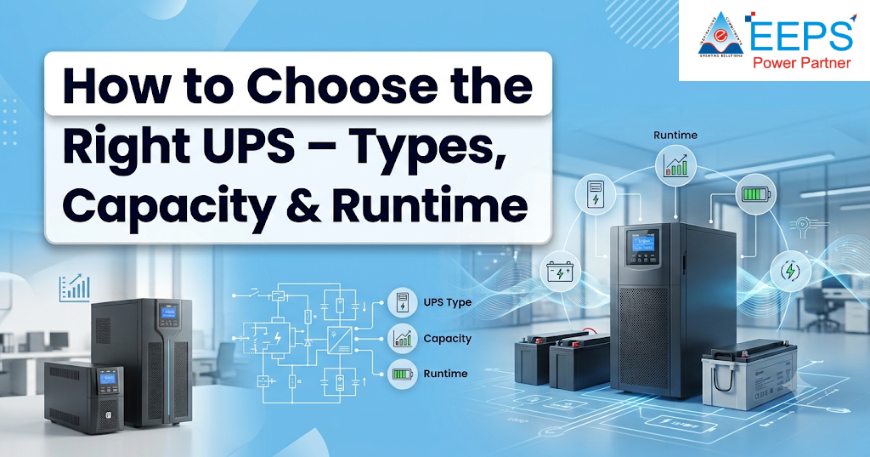
Power interruptions are becoming increasingly common, making a reliable power backup system essential for homes, offices, commercial solar rooftops establishments, healthcare facilities, educational institutions, and industrial operations. A UPS (Uninterruptible Power Supply) ensures that your critical equipment continues operating during unexpected power failures while protecting valuable devices from voltage fluctuations, surges, and electrical disturbances.
Understanding How to Choose the Right UPS – Types, Capacity & Runtime is essential before investing in a power backup solution. Selecting the wrong UPS can lead to insufficient backup time, equipment overload, unnecessary maintenance costs, and reduced system performance. Choosing the right UPS not only protects your electronic equipment but also improves operational efficiency and business continuity.
A UPS serves as the first line of defense against power-related problems. During a sudden power outage, it instantly supplies backup electricity to connected equipment, allowing systems to continue operating without interruption. This prevents data loss, protects hardware from unexpected shutdowns, and provides enough time to safely save work or switch to an alternative power source.
Businesses rely heavily on continuous electricity to maintain productivity and customer service. Even a few minutes of downtime can result in financial losses, operational delays, and damaged equipment. Hospitals require uninterrupted power for life-saving medical equipment, while educational institutions depend on stable electricity for digital learning environments. Choosing the correct UPS ensures reliable protection across all these applications.
By understanding How to Choose the Right UPS – Types, Capacity & Runtime, businesses and homeowners can make informed decisions that improve safety, reliability, and long-term value.
One of the most important factors when selecting a UPS is identifying the correct type for your application. Different UPS technologies provide different levels of protection, efficiency, and performance.
Standby UPS systems are commonly used in homes and small offices where occasional power interruptions occur. These systems automatically switch to battery backup whenever utility power fails, making them an economical solution for computers, networking devices, and personal electronics.
A Line-Interactive UPS provides both battery backup and automatic voltage regulation. It helps stabilize fluctuating voltages without relying on battery power, making it suitable for businesses experiencing frequent voltage variations. This type of UPS extends battery life while offering improved equipment protection.
Online UPS systems deliver the highest level of power protection by continuously supplying clean electricity through double-conversion technology. Since connected equipment always receives conditioned power, Online UPS systems eliminate power interruptions completely. These systems are ideal for hospitals, data centers, industrial facilities, financial institutions, and mission-critical applications where continuous operation is essential.
At Essar Power, we help customers select the UPS technology that best matches their operational requirements, budget, and future expansion plans.
Selecting the correct UPS capacity is equally important. UPS systems are measured in Volt-Amps (VA) or Kilovolt-Amps (kVA), which indicate the amount of electrical load they can support. Choosing a system with insufficient capacity may overload the UPS and reduce its effectiveness, while purchasing an oversized system can increase installation costs unnecessarily.
To determine the ideal UPS capacity, it is important to calculate the total power consumption of all connected equipment. Future expansion should also be considered, especially for businesses expecting increased energy requirements over time.
Several factors influence UPS capacity selection, including:
The experts at Essar Power perform detailed load assessments to recommend UPS systems that provide dependable performance while maximizing energy efficiency.
Another critical factor in How to Choose the Right UPS – Types, Capacity & Runtime is determining the required backup duration. Runtime refers to the length of time a UPS can supply electricity during a power outage.
Some organizations require only a few minutes of backup to save data and safely shut down systems, while others need extended runtime until diesel generators or alternative power sources become operational.
Runtime depends on several factors, including battery capacity, connected load, UPS efficiency, and future power requirements. Selecting the correct battery configuration ensures uninterrupted business operations while avoiding unnecessary battery costs.
Essar Power offers scalable battery solutions that allow customers to increase runtime according to their operational needs without replacing the entire UPS system.
Before investing in a UPS, several important factors should be carefully evaluated to ensure the selected system delivers maximum value and long-term reliability.
The installation environment plays a significant role in UPS performance. Proper ventilation, temperature control, and available installation space all contribute to system efficiency and battery life. Businesses should also consider maintenance requirements, energy efficiency ratings, warranty coverage, and the availability of professional technical support.
Another important consideration is future expansion. Purchasing a UPS that supports additional equipment allows businesses to scale operations without replacing their existing backup system.
Working with an experienced provider like Essar Power ensures that every aspect of UPS selection is professionally evaluated, helping customers make informed decisions based on their actual power requirements.
UPS systems are used across a wide range of industries where uninterrupted power is essential for daily operations.
Commercial offices depend on UPS systems to protect computers, servers, networking equipment, and communication systems from unexpected shutdowns. Hospitals require continuous power for medical devices, diagnostic equipment, and emergency services. Manufacturing industries rely on UPS systems to prevent production interruptions and equipment damage during power failures.
Educational institutions use UPS systems to support digital classrooms, laboratories, and administrative operations, while retail businesses protect billing systems, surveillance equipment, and payment terminals from downtime.
No matter the industry, choosing the right UPS improves productivity, minimizes risks, and enhances operational reliability.
When selecting a UPS provider, experience and technical expertise are just as important as product quality. Essar Power has earned the trust of customers by delivering reliable power backup solutions that combine advanced technology with professional service.
Our team provides complete UPS solutions, including consultation, system design, load analysis, installation, testing, commissioning, and preventive maintenance. Every project is customized according to the customer’s operational requirements, ensuring maximum efficiency and long-term performance.
We use premium-quality UPS systems and batteries from trusted manufacturers to provide dependable backup power for residential, commercial, and industrial applications. Our commitment to customer satisfaction, timely service, and ongoing technical support makes Essar Power a preferred partner for reliable power backup solutions.
For complete power management, you can also explore our Online UPS Solutions, Industrial UPS Installation Services, and Power Backup Maintenance Services to find the right solution for your specific requirements.
Contact Us Essar Power Today to discuss your power backup requirements, receive professional recommendations, and benefit from reliable UPS installation and maintenance services.
Let Essar Power help you protect your valuable equipment and ensure uninterrupted operations with the right UPS solution.
How to Choose the Right UPS – Types, Capacity & Runtime helps you select the ideal UPS by evaluating load capacity, backup time, UPS type, battery quality, and future expansion needs.
How to Choose the Right UPS – Types, Capacity & Runtime explains the differences between Offline, Line Interactive, and Online UPS systems for homes, offices, and industries.
How to Choose the Right UPS – Types, Capacity & Runtime recommends calculating total equipment wattage, converting it to VA, and adding extra capacity for reliable performance.
How to Choose the Right UPS – Types, Capacity & Runtime explains how runtime keeps your equipment running during power outages.
How to Choose the Right UPS – Types, Capacity & Runtime shows how a quality UPS protects devices from voltage fluctuations, surges, power failures, and unexpected downtime.
Copyright © 2026 Essar Enterprise Power Solutions | Designed by Web Rocz
WhatsApp us