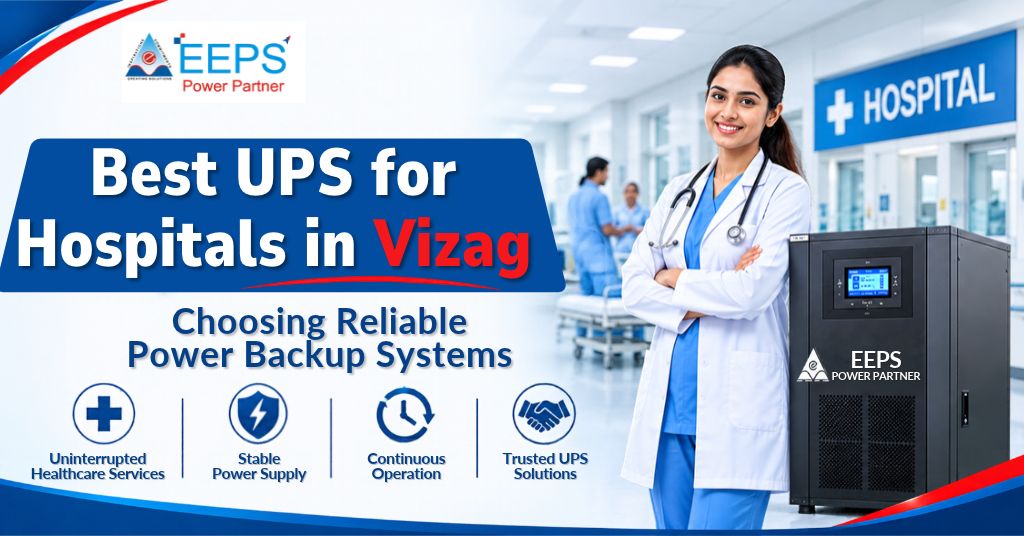
Hospitals cannot afford unexpected power interruptions, especially when patients depend on life-support equipment, operation theatres and diagnostic machines. Choosing the Best UPS for Hospitals in Vizag Reliable Power Backup is an important step towards maintaining continuous healthcare services and protecting sensitive medical equipment.
Visakhapatnam has a growing healthcare infrastructure, with multispeciality hospitals, diagnostic centres, nursing homes and speciality clinics increasingly depending on advanced medical technology. These facilities need dependable power backup systems that can respond immediately when the main electricity supply fails.
A properly designed UPS system helps hospitals maintain essential operations, avoid sudden equipment shutdowns and provide a safer environment for patients and healthcare professionals.
Electricity is essential for almost every department in a modern hospital. From patient monitoring systems to diagnostic imaging equipment, several medical devices require a stable and continuous power supply.
Even a short power interruption can affect medical procedures, interrupt diagnostic tests or cause computer systems to shut down unexpectedly.
The Best UPS for Hospitals in Vizag should provide more than temporary backup. It should also protect equipment against voltage fluctuations, electrical disturbances and unexpected power failures.
Patient safety:
Maintains power to essential medical equipment during interruptions.
Continuous operations:
Helps critical departments function without unexpected shutdowns.
Equipment protection:
Protects sensitive electronics from electrical disturbances.
Data protection:
Prevents sudden shutdowns of hospital servers and digital medical records.
Operational efficiency:
Reduces interruptions to medical procedures and diagnostic activities.
For hospitals, investing in the right UPS infrastructure is an important part of electrical and operational planning.
An online double-conversion UPS is generally a suitable choice for critical hospital applications because it continuously supplies conditioned power to connected equipment.
Unlike conventional backup systems, an online UPS converts incoming AC power into DC and then back into AC. This process helps provide a stable output and avoids the transfer interruption associated with conventional standby UPS systems.
However, not every hospital requires the same UPS configuration. The ideal system depends on equipment sensitivity, electrical load, criticality and required backup duration.
The following UPS solutions are commonly considered for healthcare facilities.
1. Online UPS Systems
Online UPS systems are particularly useful for sensitive medical equipment that cannot tolerate interruptions in power supply.
They are commonly considered for:
When selecting the Best UPS for Hospitals in Vizag, hospitals should consider online UPS technology for applications where power continuity and output stability are essential.
Medical-grade UPS solutions are designed for healthcare environments where electrical safety and power reliability are particularly important.
Depending on the application, these systems may be integrated with medical isolation transformers, insulation monitoring devices and dedicated electrical distribution arrangements.
They can be considered for:
The UPS alone does not replace the need for a properly engineered medical electrical installation. Hospitals should consult qualified electrical and healthcare infrastructure professionals before selecting equipment.
3. Modular UPS Systems
Modular UPS systems offer flexibility for hospitals that need scalable power backup infrastructure.
Instead of depending entirely on a single large unit, modular configurations allow additional power modules to be incorporated as requirements increase.
Their advantages include:
For larger healthcare facilities, modular UPS systems can be considered as part of a carefully designed power backup strategy.
4. High-Capacity Industrial UPS Systems
Large hospitals often have multiple departments operating simultaneously. Their electrical requirements may include advanced diagnostic equipment, server rooms, medical laboratories and other essential infrastructure.
High-capacity three-phase UPS systems can support larger electrical loads when correctly specified.
The required capacity should be calculated after assessing connected loads, power factor, starting characteristics, future expansion and backup requirements.
A hospital has several departments with different electrical requirements. Rather than connecting every device to one common UPS, it is often better to plan power backup according to departmental needs.
Hospital department – UPS application
ICU – Patient monitoring and critical care equipment
Operation Theatre – Essential surgical and medical equipment
Emergency Department – Critical monitoring and treatment devices
Diagnostic Centre – Selected imaging and diagnostic systems
Laboratory – Sensitive testing and analysis equipment
Server Room – Hospital management systems and patient records
Pharmacy – Billing, inventory and IT infrastructure
Nursing Stations – Computers and patient information systems
The Best UPS for Hospitals in Vizag should be selected after identifying which departments need immediate backup and which can operate with generator-supported backup arrangements.
Not all medical equipment should automatically be connected to the same UPS. Dedicated circuits and appropriately designed distribution systems may be necessary.
Choosing a UPS is a technical decision. Hospitals should evaluate their present electrical infrastructure and future requirements before investing in a power backup solution.
1. Calculate the Total Electrical Load
Start by identifying the equipment that needs UPS protection.
Prepare a load list covering medical devices, computers, networking systems, laboratory equipment and other essential applications.
Consider the following:
Avoid selecting a UPS based only on the total number of devices.
2. Select the Appropriate UPS Capacity
The UPS capacity must match the actual electrical load.
An undersized system may overload during peak operations, while an unnecessarily oversized system can increase initial investment and operating costs.
A professional site assessment helps determine the correct capacity and configuration.
Hospitals should also consider established healthcare infrastructure guidelines while planning their electrical and power backup systems. Refer to the Indian Public Health Standards (IPHS) for Hospitals published by the National Health Mission, Government of India.
Backup time depends on battery capacity, connected load, battery condition and system efficiency.
Different hospital departments may require different backup durations.
For example, an IT server room may have different runtime requirements from an operation theatre or critical care unit.
Hospitals should coordinate UPS backup requirements with their generator and emergency power systems.
4. Evaluate Power Quality
Medical equipment can be sensitive to voltage variations, electrical noise and sudden interruptions.
Consider UPS systems that provide:
5. Consider Redundancy
For critical hospital applications, redundancy can improve power availability.
An N+1 configuration provides an additional UPS module beyond the capacity required to support the designed load. This can help maintain service if one module becomes unavailable, provided the complete electrical arrangement is appropriately designed.
UPS installation requires suitable ventilation, electrical protection, battery arrangements and safe maintenance access.
Hospitals should also consider:
7. Choose an Experienced UPS Supplier
A reliable supplier should understand the electrical requirements of healthcare facilities.
Look for a provider that offers load assessment, product selection, professional installation, commissioning and ongoing maintenance support.
Selecting the right UPS brand is important, but choosing an experienced power solutions partner is equally valuable.
Essar Enterprise Power Solutions (EEPS) provides UPS and power management solutions for businesses, institutions and healthcare facilities.
With over 25 years of industry experience, EEPS supports organisations with power backup planning, equipment selection, installation and after-sales service. The company serves customers across Hyderabad, Visakhapatnam and other locations in India.
Here are some reasons to consider EEPS for hospital power backup requirements:
Industry experience:
More than 25 years of experience in power solutions.
Trusted technology:
Solutions featuring established brands such as Delta and Numeric.
Customised planning:
UPS capacity and configuration based on application requirements.
Professional installation:
Technical assistance from requirement assessment to commissioning.
Maintenance support:
Ongoing service and maintenance assistance.
Local presence:
A dedicated Vizag branch for regional customer support.
Whether you are setting up a new hospital, upgrading an existing facility or improving your critical power infrastructure, EEPS can help assess your requirements and recommend suitable UPS solutions.
Hospitals in Visakhapatnam operate across different scales, from small speciality clinics to large multispeciality facilities. Their power requirements naturally vary.
A small nursing home may need backup for patient monitoring, computers and emergency systems. A large hospital may require separate UPS arrangements for operation theatres, intensive care units, diagnostic equipment and IT infrastructure.
When evaluating the Best UPS for Hospitals in Vizag, consider the following planning approach:
Hospital type – Recommended planning approach
Small clinics – UPS for essential medical equipment and IT systems
Nursing homes – Dedicated backup for critical treatment areas
Multispeciality hospitals – Department-wise UPS distribution
Large hospitals – Centralised and decentralised UPS architecture with redundancy
Diagnostic centres – Equipment-specific UPS assessment
The final design should be prepared by qualified professionals after reviewing the electrical layout and clinical requirements.
Online double-conversion UPS systems are generally suitable for critical hospital applications because they provide continuous, conditioned power. Medical-grade UPS configurations may also be required for specific clinical areas depending on electrical safety requirements.
Online UPS systems provide continuous power conditioning and avoid the transfer interruption associated with conventional standby systems. They help protect sensitive medical electronics from power interruptions and electrical disturbances.
Hospital UPS capacity depends on connected equipment loads, power factor, peak demand, backup duration and future expansion. A professional load assessment is recommended before selecting the system.
Yes, a suitably designed centralised UPS arrangement can support multiple hospital loads. However, dedicated or decentralized UPS systems may be more appropriate for critical departments such as ICUs, operation theatres and diagnostic equipment.
The required backup duration depends on the department, clinical risk and availability of secondary power sources such as generators. Hospitals should determine backup duration through a proper electrical and clinical risk assessment.








Copyright © 2026 Essar Enterprise Power Solutions | Designed by Web Rocz
WhatsApp us