If you run a business in Hyderabad, you’ve probably felt that small jolt when the electricity bill arrives. Whether it’s a factory, an office, a hospital, a hotel or a warehouse, power is one of those costs that keeps growing with your business and never really goes away. So it’s no surprise that more and more business owners are asking, “Can solar actually bring this down?”
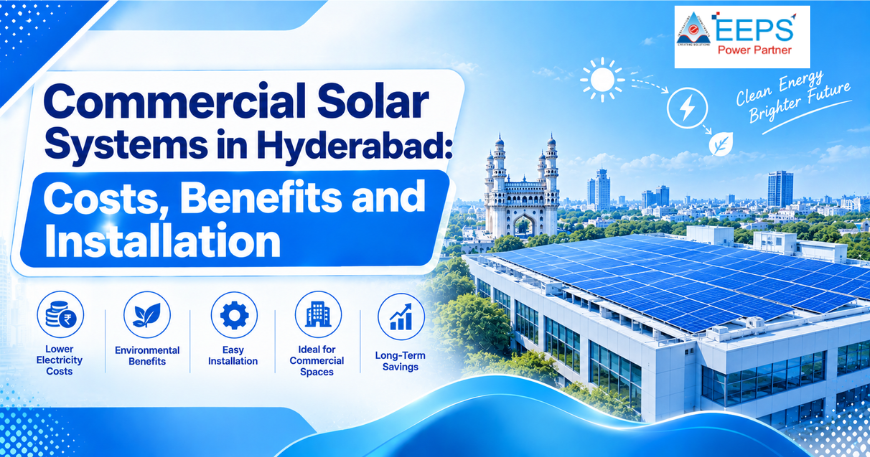
For many, the answer is yes. Hyderabad gets bright sunshine for most of the year, which makes Commercial Solar Systems in Hyderabad a practical way to produce your own electricity right from your rooftop or spare land, instead of depending entirely on the grid. That said, solar isn’t a one-size-fits-all decision. What it costs, how much you’ll save and what kind of system you need all depend on your building, your power usage and your working hours. At EEPS (Essar Enterprise Power Solutions), we’ve spent over 25 years helping Hyderabad businesses find power solutions that fit. In this guide, we’ll walk you through the costs, benefits and installation process, so you can decide whether solar is the right move for your business.
In simple terms, a commercial solar system uses photovoltaic (PV) panels to turn sunlight into electricity for your business. No two systems are exactly alike, because each one is built around how much power you use, how much space you have and the electrical setup already in your building.
They’re usually a lot bigger than home systems, and that makes sense. Businesses burn through far more electricity during the day. In an office, solar might power the lights, computers and ACs. In a factory, it might keep machines, production lines, and ventilation running. You’ve got options for where the panels go: concrete rooftops, metal-sheet factory roofs, parking shades, or open land if you have it.
Most businesses with enough roof space go for an on-grid system. It works hand in hand with your existing electricity connection, so whenever the sun is out, solar picks up part of the load. Which setup suits you depends on how you use power, what your site looks like, and the connection and approval rules that apply to you.
This is usually the first thing people want to know, and fair enough. The price depends on a few things: how big the system is, which panels and inverters you pick, the mounting structures, electrical work, how tricky the installation is, and what the grid connection involves.
These ranges are based on published commercial solar pricing and will vary from project to project. A small office might be fine with a compact setup. A large warehouse or factory, on the other hand, could get a lot more out of a bigger system.
One tip: when quotes start coming in, read the fine print. Some include everything (panels, inverters, structures, wiring, installation and monitoring), while others quietly list electrical or civil work as extras. Batteries, major structural changes and extra grid work will also add to the bill. Our advice? Get a detailed quote based on your actual electricity bills and your actual building. Don’t choose a system just because it’s the cheapest on paper.
This is the big one. The more power your panels make, the less you buy from the grid. When solar is producing during working hours, it feeds your equipment directly, so your grid usage drops. If your business runs mostly in the daytime, this works in your favour.
Picture an office where the ACs, computers and lights are on from morning to evening. That office can use a big chunk of its solar power right as it’s produced. Exactly how much you’ll save depends on your system size, your tariff, how generation changes across seasons, and how much of the solar power you actually use. Demand charges and other bill components play a part too.
Electricity isn’t a one-time expense. You pay for it every single month. When you make some of your own, you’re less at the mercy of rising grid prices. Solar panels keep working for many years. Their output does dip slowly over time, and a few parts may need replacing along the way.
Once the structure is checked, some of that space could be producing power instead. Factories, warehouses, malls, schools, colleges and office buildings often have room to spare. That said, not every roof is suitable. Shade from nearby buildings, equipment on the roof, structural strength and maintenance access all need checking before anything is designed.
Solar panels generate electricity without burning any fuel while they run. So switching to solar can help cut the emissions tied to your business’s power use. That’s useful for sustainability reports, green initiatives and general efficiency goals.
And if your clients or partners care about the environment, and more of them do every year, using renewable energy shows you’re taking it seriously. How big that environmental benefit is depends on what power source solar is replacing, how well the system performs, and the materials and energy that went into making and installing it.
This is the most popular choice. It plugs into your existing electricity supply and usually skips batteries. Solar runs your business while the sun’s out, and the grid steps in whenever solar falls short.
It’s a great fit if most of your power use happens in the daytime. Sending extra power back to the grid depends on your connection setup and local rules.
A hybrid system gives you the best of both worlds: solar panels, batteries and a grid connection. Depending on the design, it can save extra solar power for later and keep selected equipment running during outages.
It does cost more than a system without batteries. So if backup matters to you, first figure out which equipment needs power, for how long, and how much battery capacity that takes.
It needs batteries and some careful planning around your power use. It can make sense for remote sites. But if you already have a reliable grid connection, weigh the extra battery costs and upkeep against the other options before deciding.
A proper installation is much more than bolting panels onto a roof. Here’s roughly how it goes.
Step 1: Look at your electricity usage
Pull out your recent electricity bills. Note your average usage, tariff category and working hours. This tells you what system size makes sense.
Step 2: Get your site checked
First, someone needs to see your roof in person. They’ll check the space, spot any shade, make sure the roof is strong enough and look at your wiring. Simple, but it sets up everything that follows.
Step 3: Plan the design
Every building is different, so your system should be too. The panels, inverter and wiring are planned around how you actually use power.
Step 4: Get approvals
Paperwork isn’t anyone’s favourite, but it’s worth getting right. Clear the permissions and grid connection early, and the rest goes smoothly.
Step 5: Install and test
This is the day your roof starts making power. The team sets everything up and tests it properly, because safety comes first.
Step 6: Keep an eye on it
Now just sit back and watch the savings come in. Keep the panels clean, glance at the output now and then, and get it serviced on time.
Follow these steps, and you’ll have a safer, smoother installation and a much clearer picture of what to expect.
Here’s something many people learn the hard way: the installer matters as much as the panels. A low quote is tempting, but it shouldn’t be the only thing that decides it.
Start by asking about their commercial project experience, and request a detailed equipment list. Compare panel specs, inverter warranties, mounting structures, safety features, monitoring options and the after-sales support they offer.
Ask whether the quote covers installation, testing, commissioning, paperwork and help with grid-connection formalities.
Don’t forget maintenance. Find out who shows up if something goes wrong. Getting everything in writing makes comparing installers much easier and fairer.
If you’re exploring best commercial solar systems in Hyderabad, go with someone who knows local conditions and can explain the technical and money side in plain language, without jargon.
That’s exactly what we do at EEPS (Essar Enterprise Power Solutions). We help Hyderabad businesses plan and install rooftop and on-grid solar systems, from the first site visit right through to after-sales support. Have questions about going solar? Our team is happy to talk it through.
At EEPS (Essar Enterprise Power Solutions), we’ve been helping Hyderabad businesses with their power needs for over 25 years. We don’t sell standard packages. We study your roof, bills and working hours, then design a rooftop or on-grid solar system that fits your business. Our certified engineers handle the full installation, and our 24/7 support and AMC plans keep your system running well for years.
Contact us today to start cutting your electricity bills with solar. The EEPS team is here to help.
Commercial solar systems in Hyderabad typically cost ₹8–12 lakh for 20 kW and ₹75 lakh–₹1 crore for 200 kW, depending on site conditions.
Savings depend on your tariff and daytime usage. Businesses that run during the day save the most with commercial solar systems in Hyderabad.
On-grid works for most businesses. Hybrid commercial solar systems in Hyderabad are better if you need backup during power cuts.
A site survey checks shading, space and structural strength to confirm whether your roof can support commercial solar systems in Hyderabad.
Yes, mainly regular cleaning and inspections. With an AMC, commercial solar systems in Hyderabad run reliably for years.



Copyright © 2026 Essar Enterprise Power Solutions | Designed by Web Rocz
WhatsApp us