Higher education is becoming increasingly digital, and colleges are adopting advanced classroom technologies to create more engaging learning environments. Traditional boards and conventional presentation methods are gradually being complemented by interactive displays that allow educators and students to work with digital content in real time.
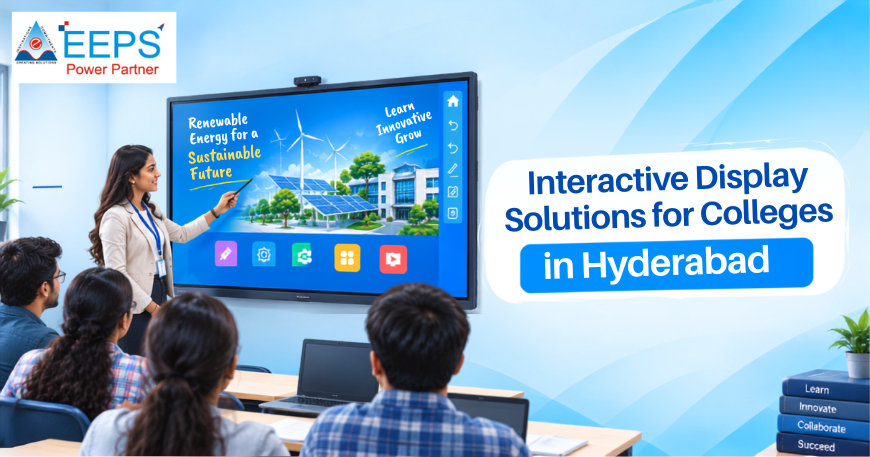
Interactive Display Solutions for Colleges in Hyderabad provide colleges with a modern platform for lectures, presentations, demonstrations, collaborative activities, seminars, and digital learning. These displays combine large high-resolution screens with touch technology, multimedia capabilities, connectivity, and digital annotation tools. Essar Power offers solutions that can support the evolving technology needs of modern educational institutions. For colleges across Hyderabad, the right interactive display can transform an ordinary classroom into a technology-enabled learning space while supporting different teaching styles and academic requirements.
Interactive display solutions are large touchscreen systems designed to support teaching, presentations, collaboration, and digital content. Unlike a standard display that only shows information, an interactive panel allows teachers and students to directly interact with what is displayed.
Faculty members can write notes, highlight information, draw diagrams, display presentations, play educational videos, open digital resources, and interact with applications directly from the screen. Students can also participate in activities and collaborative exercises. This makes interactive displays useful for classrooms, laboratories, seminar halls, conference rooms, training spaces, and other academic environments.
College students interact with a wide variety of educational content. Depending on the course, lessons may involve presentations, diagrams, simulations, videos, research materials, software demonstrations, and online resources.
A modern Interactive Display Solutions provides a central platform for presenting these resources. Instead of relying on separate equipment for every type of content, faculty can use one integrated display for multiple teaching activities. For colleges, this can create a more flexible learning environment while helping educators incorporate technology into regular classroom sessions.
A high-resolution screen provides clear visibility for text, images, graphs, presentations, diagrams, and videos. This is particularly important in larger lecture rooms where students may be seated at considerable distances from the display. Clear visuals can also make detailed academic content easier to understand.
Touch functionality allows faculty members to write, draw, annotate, move objects, and interact with digital content directly on the screen. This can make lectures more dynamic and reduce the dependence on traditional writing boards.
Multi-touch technology can support collaborative learning activities. Multiple students can interact with content simultaneously, making it useful for group exercises, problem-solving sessions, demonstrations, and presentations.
Faculty can annotate presentations, documents, diagrams, images, and other content during a lecture. Important points can be highlighted and explanations can be added directly to the displayed material. This can make complex academic concepts easier to explain visually.
Modern college education frequently uses videos, animations, presentations, audio, diagrams, and interactive applications. An interactive display provides a convenient platform for combining these resources within a single lesson.
Interactive displays can connect with laptops, computers, networks, and compatible external devices. This enables faculty to access different teaching resources and present content from multiple sources.
Long lectures can sometimes make it difficult to maintain student attention. Interactive displays allow faculty to combine different types of content and create more visually engaging sessions. A lecture can move from a presentation to a video, diagram, digital annotation, or interactive activity without requiring a major change in setup.
Interactive technology can encourage students to participate more actively. Instead of only listening to lectures, students can interact with content, solve problems, contribute ideas, and participate in group activities. This can help create a more collaborative academic environment.
Colleges increasingly use digital resources as part of their academic programmes. Interactive displays make it easier to incorporate digital textbooks, presentations, online resources, videos, research materials, and other educational content.
Some academic concepts are easier to understand through visual demonstrations. Graphs, diagrams, simulations, models, and videos can provide additional context that may not be possible through text alone.
Different faculty members use different approaches to teaching. Interactive displays can support presentations, digital writing, multimedia demonstrations, collaborative exercises, and visual explanations. This flexibility allows educators to adapt technology according to their subject and teaching objectives.
Interactive displays can be used across a wide range of academic disciplines.
Engineering colleges can use interactive displays for technical diagrams, CAD-related demonstrations, simulations, coding concepts, presentations, and project discussions.
Medical and life-science departments can use high-quality displays to present anatomical diagrams, medical images, educational videos, laboratory concepts, and visual demonstrations.
Management students can benefit from presentations, business case studies, charts, financial models, market research, and collaborative discussions displayed on interactive screens.
History, literature, sociology, political science, and other humanities subjects can incorporate photographs, timelines, maps, documentaries, presentations, and digital research materials.
Physics, chemistry, mathematics, and other science departments can use interactive displays for equations, graphs, diagrams, experiments, simulations, and problem-solving exercises.
Interactive displays are not limited to standard classrooms. They can also be used in lecture halls, seminar rooms, meeting spaces, faculty training rooms, and conference facilities.
During seminars, presenters can display research findings, videos, graphs, presentations, and supporting documents. Touch functionality can also allow presenters to annotate information while explaining a topic. In faculty meetings and training sessions, interactive displays can support presentations and collaborative discussions.
Colleges are increasingly using a combination of classroom-based and digital learning methods. Interactive displays can support this transition by providing a central platform for digital content.
Faculty can use presentations, online resources, videos, documents, and other digital materials during classroom sessions. Depending on the college’s overall technology infrastructure, interactive displays can also complement online teaching and hybrid learning environments.
Selecting an Advanced Interactive Display requires careful consideration of the college’s academic and infrastructure requirements. Screen size should match the room dimensions and viewing distance. Display resolution should provide clear visuals, while touch responsiveness should support smooth interaction.
Colleges should also consider connectivity, operating system compatibility, built-in audio, software support, durability, ease of operation, and energy efficiency. Another important factor is after-sales support. Professional installation, technical assistance, maintenance, and user training can help colleges achieve better long-term value from their investment.
Higher education is constantly evolving. New teaching methods, digital resources, online learning platforms, and collaborative technologies are becoming part of academic environments.
Interactive Display Solutions for Colleges in Hyderabad can help institutions prepare their classrooms for these changes by creating flexible digital learning spaces. Rather than using technology only for presentations, colleges can integrate interactive displays into everyday teaching, group activities, seminars, demonstrations, and academic discussions.
Choosing the right technology partner is an important part of implementing interactive classroom infrastructure. Essar Power focuses on providing technology solutions that align with the practical requirements of educational institutions.
Our approach considers classroom size, intended usage, connectivity requirements, academic applications, and future expansion when recommending suitable solutions.
From product guidance and installation to technical assistance, Essar Power can support colleges throughout the implementation process and help them make effective use of modern classroom technology. For institutions seeking Interactive Display Solutions for Colleges in Hyderabad, professional guidance can help ensure that the selected system provides practical value for both faculty and students.
Interactive displays are helping colleges create more engaging, collaborative, and technology-enabled learning environments.
Contact our team today for professional guidance, installation support, and reliable digital classroom solutions designed for modern colleges in Hyderabad.
Interactive Display Solutions for Colleges in Hyderabad support digital teaching, presentations, and classroom collaboration.
Interactive Display Solutions for Colleges in Hyderabad make lessons more engaging and easier to explain.
Yes, Interactive Display Solutions for Colleges in Hyderabad are suitable for different academic departments.
Yes, Interactive Display Solutions for Colleges in Hyderabad support hybrid classes, video lessons, and online learning.
Professional installation ensures Interactive Display Solutions for Colleges in Hyderabad deliver reliable classroom performance.


Copyright © 2026 Essar Enterprise Power Solutions | Designed by Web Rocz
WhatsApp us